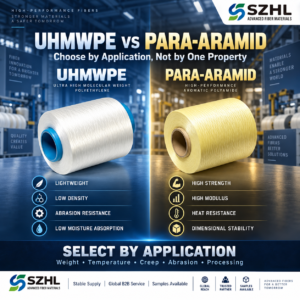
UHMWPE Fiber vs Para-Aramid Fiber: Key Differences and How to Choose

What Is UHMWPE Fiber?
UHMWPE stands for Ultra-High Molecular Weight Polyethylene. UHMWPE fiber is a high-performance synthetic fiber characterized by a very high strength-to-weight ratio, low density, excellent chemical resistance, very low moisture absorption and good fatigue resistance.
Its density is approximately 0.97 g/cm³, making it significantly lighter than many other high-performance fibers. This low density is particularly valuable in applications where reducing total system weight is important.
Typical applications include high-performance ropes, marine and offshore equipment, protective materials, composite reinforcement, industrial cordage and outdoor products.
Learn more about our
UHMWPE Fiber
specifications and available grades.
What Is Para-Aramid Fiber?
Para-aramid filament yarn is a high-performance aromatic polyamide fiber known for high tensile strength, high modulus, excellent heat resistance, inherent flame retardancy and good chemical stability.
Compared with UHMWPE, para-aramid has a higher density, but it offers significantly better resistance to elevated temperatures and flame exposure.
Typical applications include protective equipment, high-strength ropes and cables, rubber reinforcement, friction materials and advanced composite reinforcement.
Learn more about our
Para-Aramid Filament Yarn
specifications and available grades.
UHMWPE vs Para-Aramid: Technical Comparison
| Property | UHMWPE Fiber | Para-Aramid Fiber | Selection Consideration |
|---|---|---|---|
| Typical Linear Density | 200–3000D 220–3330 dtex |
200–3000D 220–3330 dtex |
Both materials are available in a broad range of specifications. |
| Tensile Strength | Approx. 30–45 cN/dtex depending on grade | Approx. 21–28 cN/dtex depending on grade | UHMWPE offers very high specific strength. |
| Tensile Modulus | Approx. 800–1600 cN/dtex depending on grade | Approx. 500–1200 cN/dtex depending on grade | Grade selection is important when stiffness is a critical requirement. |
| Density | Approx. 0.97 g/cm³ | Approx. 1.44 g/cm³ | UHMWPE provides a substantial weight advantage. |
| Elongation at Break | Approx. 2.5–4.0% | Approx. 2.0–4.0% depending on grade | Both offer relatively low elongation compared with many conventional fibers. |
| Heat Resistance | Melting point around 135°C | Long-term heat resistance ≥ 200°C; decomposition temperature ≥ 500°C | Para-aramid is more suitable for elevated-temperature environments. |
| Limiting Oxygen Index | Approx. 17–18% | ≥ 28% | Para-aramid provides better inherent flame resistance. |
| Moisture Regain | ≤ 0.01% | Approx. 3.0–5.0% | UHMWPE absorbs extremely little moisture. |
Note: Values shown above are typical reference values. Actual performance varies according to grade, specification, manufacturing process and test method. Final material selection should be based on the applicable product TDS and the requirements of the specific application.
Standardized tensile testing methods such as
ASTM International test standards
are commonly used when evaluating yarn and fiber mechanical properties.
1. Strength-to-Weight Ratio
One of the most important differences between UHMWPE and para-aramid is density.
UHMWPE fiber has a typical density of approximately 0.97 g/cm³, while para-aramid is approximately 1.44 g/cm³. When two systems require similar high-strength performance, UHMWPE can therefore provide a significant advantage where minimizing weight is a priority.
This is one reason UHMWPE is frequently considered for lightweight ropes, marine systems, lifting products, protective structures and outdoor applications.
Para-aramid remains a high-strength fiber, but its main advantage is not minimum density. Instead, it offers a different balance of strength, stiffness, heat resistance and flame resistance.
2. Heat and Flame Resistance
Heat resistance is one of the clearest differences between these two fiber families.
UHMWPE has a relatively low melting temperature compared with para-aramid. Its typical reference melting point is around 135°C, so applications involving prolonged high-temperature exposure require careful evaluation.
Para-aramid is much more suitable for elevated-temperature environments. Typical grades in our reference data provide long-term heat resistance of at least 200°C and decomposition temperatures of at least 500°C.
Para-aramid also has a higher limiting oxygen index. This makes it a more natural candidate when flame resistance and thermal stability are important design requirements.
Applications such as heat-resistant protective clothing, friction materials and certain high-temperature industrial components therefore tend to favor para-aramid.
3. Moisture and Marine Environments
UHMWPE has extremely low moisture regain, with a typical reference value of no more than 0.01%.
This characteristic, combined with its low density and chemical resistance, makes UHMWPE particularly interesting for marine, offshore and outdoor environments.
Para-aramid has a higher moisture regain, typically around 3–5% in the reference grades shown in our product data. This does not prevent its use in demanding applications, but moisture exposure should be considered as part of system design, storage and long-term performance evaluation.
4. Ropes and Cables
When comparing UHMWPE vs Para-Aramid for rope applications, operating temperature, weight, moisture exposure, abrasion and construction are critical selection factors.
UHMWPE is particularly attractive when low weight, high specific strength, low moisture absorption and handling efficiency are important.
Para-aramid becomes attractive when the rope or cable may face higher temperatures or where thermal stability is more important than obtaining the lowest possible weight.
Other factors such as construction, twist, coating, abrasion environment, termination design and cyclic loading should also be evaluated before choosing a final yarn grade.
5. Protective Applications
Both materials are used in protective systems, but they should not be treated as interchangeable.
UHMWPE is widely associated with lightweight protective structures where high specific strength is valuable.
Para-aramid combines high strength with better heat and flame resistance, making it suitable for applications where thermal exposure may also be present.
For a protective system, the correct decision should consider not only fiber strength, but also layer construction, resin or matrix system, temperature, impact requirements, environmental exposure and applicable certification standards.
6. Composite Reinforcement
UHMWPE and para-aramid can both serve as reinforcement materials in advanced composites.
UHMWPE can help reduce weight and provide high specific mechanical performance. Para-aramid can provide high strength, dimensional stability and greater resistance to elevated temperatures.
The correct reinforcement depends heavily on the matrix, processing temperature, bonding requirements, load direction and final component environment.
When Should You Choose UHMWPE Fiber?
UHMWPE is generally worth evaluating when your project prioritizes:
- Very low weight
- High strength-to-weight ratio
- Extremely low moisture absorption
- Marine or outdoor use
- High-performance ropes and cordage
- Lightweight protective structures
- Low-density composite reinforcement
When Should You Choose Para-Aramid Fiber?
Para-aramid is generally worth evaluating when your project prioritizes:
- High tensile strength and modulus
- Higher operating temperatures
- Inherent flame resistance
- Dimensional stability
- Protective equipment
- Rubber reinforcement
- Friction materials
- High-temperature ropes, cables or composites
UHMWPE vs Para-Aramid: Which Should You Choose?
There is no universal winner in the UHMWPE vs Para-Aramid comparison.
UHMWPE and para-aramid solve different engineering problems. UHMWPE offers an especially attractive combination of low density, high specific strength and extremely low moisture absorption. Para-aramid provides a stronger thermal and flame-resistance profile while maintaining high strength and modulus.
The better material is therefore the one that matches the actual operating environment.
For example, a lightweight marine rope and a heat-resistant reinforcement yarn may both require high strength, but their material requirements are fundamentally different.
Frequently Asked Questions
Is UHMWPE stronger than para-aramid?
In the typical grades shown in our reference data, UHMWPE has a higher tensile strength range on a cN/dtex basis. However, material selection should not be made from tensile strength alone. Temperature, creep, construction, abrasion, environmental exposure and application requirements must also be considered.
Which fiber is lighter?
UHMWPE is lighter. Its typical density is approximately 0.97 g/cm³ compared with approximately 1.44 g/cm³ for para-aramid.
Which fiber is better for high-temperature applications?
Para-aramid is generally the more suitable choice when high-temperature resistance is important. UHMWPE has a much lower melting temperature and therefore requires more careful temperature control.
Which fiber absorbs less moisture?
UHMWPE has extremely low moisture absorption. This is one of its major advantages in marine and outdoor environments.
Can both materials be used for ropes?
Yes. Both UHMWPE and para-aramid can be used in high-performance rope and cable systems. The correct choice depends on weight, temperature, load, abrasion, environmental exposure and rope construction.
Need Help Selecting the Right Fiber?
SZHL supplies UHMWPE fiber and para-aramid filament yarn in multiple specifications for industrial evaluation and global B2B applications.
If you are comparing materials for ropes, protective equipment, composites or other demanding applications, send us your target specification, operating temperature, required strength and end-use information.
We can help match an appropriate specification and provide samples for evaluation.