Meta-Aramid vs Para-Aramid: What’s the Difference?
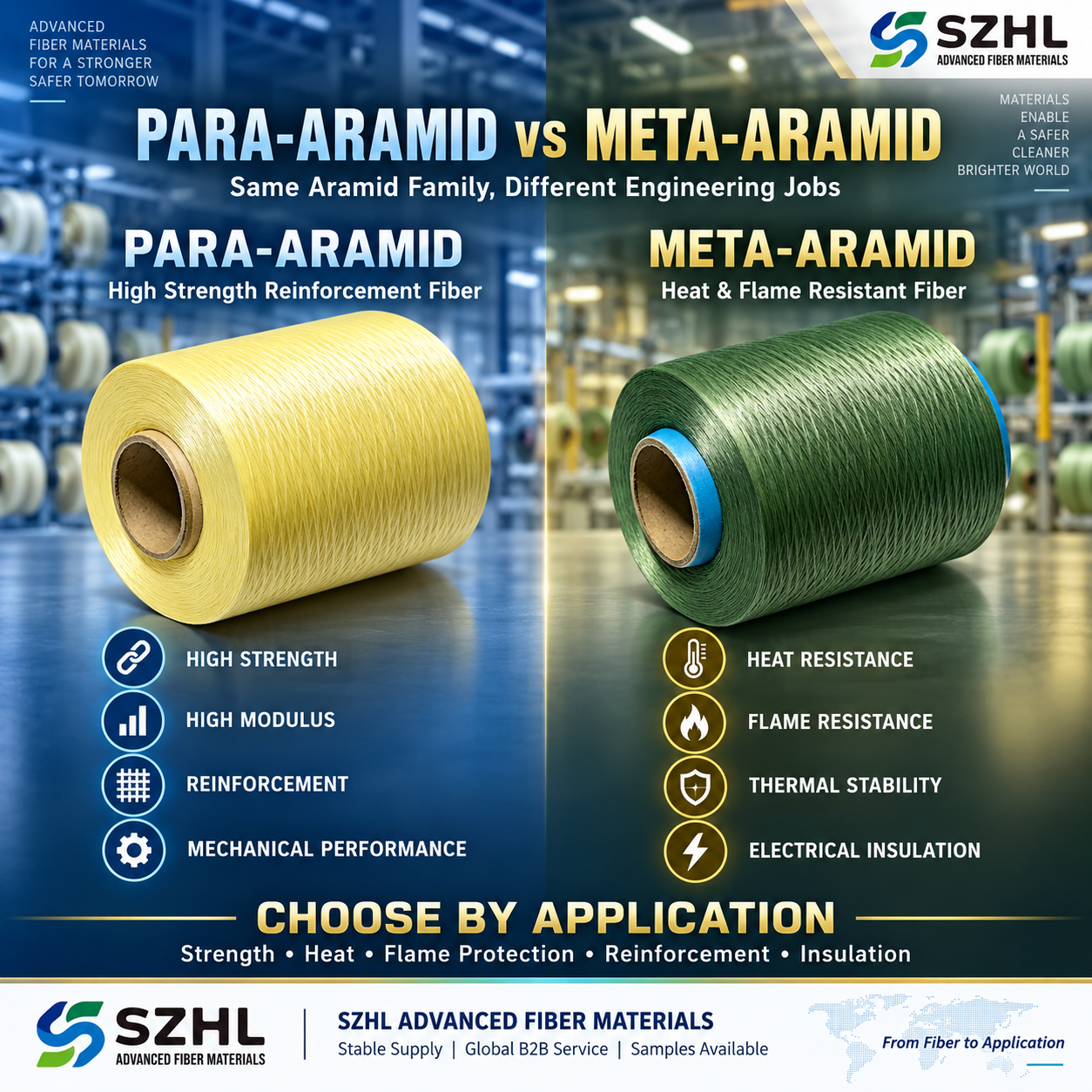
Meta-Aramid vs Para-Aramid is one of the most common comparisons when engineers and sourcing teams evaluate aramid fibers for protective textiles, industrial fabrics, ropes, cables and composite reinforcement.
Although both materials belong to the aramid family, their molecular structures create very different performance profiles. Meta-aramid is primarily valued for heat resistance, flame resistance, electrical insulation and flexibility, while para-aramid is selected when high tensile strength, high modulus and load-bearing performance are the main priorities.
This guide explains the practical differences between meta-aramid and para-aramid and helps identify which material is more suitable for different applications.
What Is Meta-Aramid Fiber?
Meta-aramid is a heat-resistant aromatic polyamide fiber designed primarily for demanding thermal, flame-resistant and electrical-insulation environments.
Compared with many conventional synthetic fibers, meta-aramid provides excellent thermal stability and does not behave like a typical low-melting thermoplastic fiber under elevated temperatures.
SZHL currently supplies meta-aramid filament yarn in standard 200D and 1200D specifications, with white and green as standard color options and additional colors available on request.
View our Meta-Aramid Filament Yarn for available specifications and sample options.
What Is Para-Aramid Fiber?
Para-aramid is a high-strength, high-modulus aromatic polyamide fiber developed for applications that require excellent tensile performance, dimensional stability and low creep under sustained load.
It is widely used in high-performance ropes, cables, protective materials, rubber reinforcement and advanced composites where mechanical strength is a major design requirement.
Para-aramid fibers typically have much lower elongation and significantly higher tensile strength than meta-aramid fibers.
View our Para-Aramid Filament Yarn for available grades and specifications.
Meta-Aramid vs Para-Aramid: Quick Comparison
| Property | Meta-Aramid | Para-Aramid | Typical Selection Focus |
|---|---|---|---|
| Main Advantage | Heat resistance, flame resistance and electrical insulation | High tensile strength and high modulus | Choose based on thermal vs mechanical requirements. |
| Typical Tensile Behavior | Moderate strength with higher flexibility | Very high strength and stiffness | Para-aramid is preferred for load-bearing reinforcement. |
| Elongation | Typically higher | Typically lower | Meta-aramid offers more flexibility; para-aramid provides greater dimensional stability. |
| Heat & Flame Performance | Excellent thermal stability and inherent flame resistance | Good heat resistance with strong mechanical retention | Meta-aramid is commonly favored when thermal protection is the primary function. |
| Electrical Insulation | Widely used | Used in selected cable and reinforcement applications | Meta-aramid is commonly selected for insulation textiles and cable protection. |
| Typical Applications | Protective clothing, filtration, insulation, industrial textiles | Ropes, cables, composites, reinforcement, protective systems | Application function usually determines the fiber choice. |
Note: The values and performance characteristics discussed in this article are typical reference information. Actual properties vary by grade, specification and production conditions. Contact SZHL for technical confirmation before final material selection.
1. Strength and Modulus
The largest practical difference between meta-aramid and para-aramid is mechanical strength.
Para-aramid is engineered for high tensile loads. Its molecular chains are highly oriented, creating a fiber with high strength, high modulus and relatively low elongation.
This makes para-aramid suitable for applications such as ropes, tension members, cable reinforcement, rubber reinforcement and structural composites.
Meta-aramid has substantially lower tensile strength and modulus, but this is not necessarily a disadvantage. Its primary role is usually thermal protection, flexibility, flame resistance or insulation rather than maximum load-bearing capacity.
2. Heat and Flame Resistance
Both meta-aramid and para-aramid belong to the heat-resistant aramid family, but they are often selected for different thermal functions.
Meta-aramid is especially well known for protective textiles, firefighting clothing, thermal barriers, high-temperature filtration and electrical insulation.
For SZHL meta-aramid filament yarn, typical reference data indicate long-term heat resistance around 200–220°C and a limiting oxygen index of at least 28.
Para-aramid also provides good thermal stability, but its strongest advantage is that it combines heat resistance with significantly higher mechanical strength.
3. Elongation and Flexibility
Meta-aramid generally has higher elongation than para-aramid.
For the SZHL 200D and 1200D meta-aramid filament yarn grades, typical elongation at break is approximately 15–25%.
Para-aramid reference fibers commonly show much lower elongation, making them more suitable for applications where dimensional stability and load transfer are important.
This difference is important when designing woven fabrics, protective structures, cables and composite reinforcement.
4. Protective Clothing and Heat-Resistant Textiles
Meta-aramid is frequently selected for protective clothing where thermal exposure and flame resistance are key requirements.
Typical applications include firefighting suits, heat-resistant garments, industrial protective clothing and other technical textiles exposed to elevated temperatures.
Para-aramid can also be incorporated into protective systems when additional mechanical strength, cut resistance or reinforcement is required.
In some applications, manufacturers combine different aramid fibers to achieve a balance between thermal protection, mechanical strength and textile flexibility.
5. Ropes, Cables and Load-Bearing Applications
When comparing Meta-Aramid vs Para-Aramid for ropes and cables, para-aramid is generally the more relevant material for load-bearing applications.
Its high tensile strength, high modulus and low elongation allow it to function as a strength member in high-performance ropes, power cables and other tension systems.
Meta-aramid is more commonly used in cable protection, insulation, sleeving and heat-resistant covering applications rather than as the primary high-strength load-bearing element.
6. Electrical Insulation
Electrical insulation is an important application area for meta-aramid.
Meta-aramid can be used in cable protection, insulation fabrics, electrical tapes and other technical systems where heat resistance and dielectric performance are important.
Para-aramid also appears in cable systems, but it is often used primarily as a strength member rather than as the main insulating material.
7. Composite Reinforcement
Both fibers can be used in composite systems, but their functions differ.
Para-aramid is commonly used where high tensile strength, impact resistance and structural reinforcement are required.
Meta-aramid can be considered where thermal stability, flame resistance or specialized technical textile reinforcement is more important than maximum tensile strength.
When Should You Choose Meta-Aramid?
Meta-aramid is generally worth evaluating when the application prioritizes:
- Heat-resistant textiles
- Fire-resistant protective clothing
- Electrical insulation
- High-temperature filtration
- Thermal barriers
- Industrial fabrics
- Flexible heat-resistant protection
When Should You Choose Para-Aramid?
Para-aramid is generally worth evaluating when the application prioritizes:
- High tensile strength
- High modulus
- Low elongation
- High-performance ropes and cables
- Composite reinforcement
- Rubber and tire reinforcement
- Protective and impact-resistant structures
Meta-Aramid vs Para-Aramid: Which Should You Choose?
There is no single answer that fits every application.
If thermal protection, flame resistance, electrical insulation or high-temperature textile performance is the primary requirement, meta-aramid is usually the more appropriate material to evaluate.
If tensile strength, stiffness and load-bearing performance are the dominant requirements, para-aramid is usually the stronger candidate.
In real industrial systems, operating temperature, required strength, textile construction, chemical exposure, moisture, abrasion and processing method should all be considered before selecting the final grade.
Frequently Asked Questions
Are meta-aramid and para-aramid the same material?
No. Both are aromatic polyamide fibers, but their molecular structures and resulting performance characteristics are different.
Which aramid fiber is stronger?
Para-aramid generally provides much higher tensile strength and modulus than meta-aramid.
Which aramid is better for heat-resistant clothing?
Meta-aramid is commonly selected for heat-resistant and flame-resistant protective textiles because thermal performance and textile flexibility are key strengths.
Which fiber is better for ropes?
Para-aramid is generally more suitable for high-strength rope and cable applications because of its higher tensile strength, modulus and lower elongation.
Can meta-aramid and para-aramid be combined?
Yes. Some technical textile and protective systems combine different fiber types to balance thermal resistance, mechanical strength, flexibility and other performance requirements.
Need Help Selecting an Aramid Fiber?
SZHL supplies meta-aramid and para-aramid filament yarn for industrial evaluation, technical textiles and global B2B applications.
Send us your required denier, operating temperature, strength requirement, color and end-use information, and we can help identify an appropriate specification for evaluation.
View Meta-Aramid Filament Yarn | View Para-Aramid Filament Yarn